.jpg)


Christmas Traditions: 'Tis the Season!

The festive season is almost upon us and it’s a time of year for indulgence and merry making! In preparation for the festivities, we are all very busy, but have you ever thought about where our Christmas traditions, customs and celebrations originate from? Let’s take a look...

CHRISTMAS CARDS
A civil servant called Sir Henry Cole first introduced the idea of sending Christmas cards back in 1843. Having played an important part in introducing the Penny Post and the first postage stamps, Cole devised Christmas cards to encourage more use of the service.
As printing methods improved, Christmas cards became increasingly popular and were produced in large numbers from about 1860. In 1870 the cost of sending a Christmas card was set at a modest halfpenny. By the early 1900s, the custom had spread to Europe, especially Germany. The first cards usually featured pictures of the Nativity and by the late Victorian times, robins and snow scenes also became popular.
Despite the recent decline in sending Christmas cards, Christmas card sales still raise around £50 million for charities each year.

CHRISTMAS TREES
Evergreen trees have been used to celebrate winter festivals – both Christian and pagan – for thousands of years. Pagans festooned their homes with branches during the winter solstice to remind them of the spring to come. The Romans decorated temples with conifers at the festival of Saturnalia. Christians see them as a symbol of everlasting life.
Tallinn in Estonia and Riga in Latvia both lay claim to the first use of a tree at Christmas, sometime in the 15th or 16th century. The first person to bring a Christmas tree indoors may have been the 16th century German preacher Martin Luther.
According to popular legend, he was walking through the forest and looked up to see the stars shining through the evergreen branches. It was so beautiful that he was inspired to share the sight with his family. He is said to have brought a tree into his home and put candles on it.
In Germany the first Christmas trees were hung with edible decorations,such as gingerbread and gilded apples. Glassmakers started to make special ornaments similar to the baubles used today. At first, a figure of the baby Jesus was put on the top of the tree but over time, this changed to an angel or the star of Bethlehem.
The first Christmas trees came to Britain sometime in the early 1800s. They gained popularity in 1841, when Prince Albert set up a Christmas tree in Windsor Castle. In Victorian times, trees were decorated with candles representing stars. While electric fairy lights have now become the norm, candles are still used to decorate Christmas trees in many parts of Europe.

CHRISTMAS PUDDING
Christmas pudding has had a chequered history. It started life as a meaty gruel in the 14th century, slowly evolved into a plum pudding, which included dried breadcrumbs, milk, meat and spices and finally became the staple Christmas dessert by the 18th century – Eliza Acton wrote the first recipe explicitly named ‘Christmas pudding’ in 1845.
Over the years, many customs have attached themselves to the Christmas pudding. One superstition says that the pudding should be made with thirteen ingredients to represent Jesus and his disciples and that every member of the family should take turns to stir the pudding with a wooden spoon from east to west, in honour of the Wise Men.
Putting a silver coin in the pudding is another age-old custom, believed to bring luck to the person who finds it.
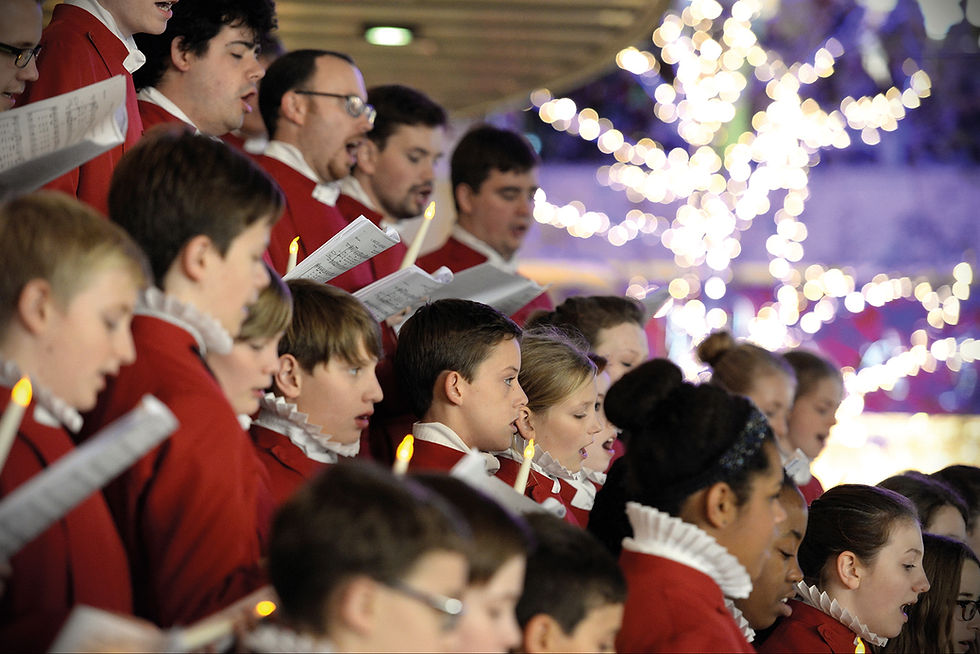
CHRISTMAS CAROLS
Originally carols were pagan songs sung all year, notably at the Winter Solstice celebrations while dancing in a circle accompanied by singing (the word carol means a dance or song of praise and joy). As Christianity started to take hold, the old pagan songs gradually evolved into Christmas carols.
After a promising start, carols went out of fashion during the early Middle Ages; possibly because they were sung in Latin. Around 1223 St. Francis of Assisi initiated a revival of carols and they grew in popularity until notorious killjoy Oliver Cromwell put a stop to them, along with all other forms of Christmas fun.
The more festive Victorians reintroduced carol singing, both in church and out on the streets.
Carols by Candlelight services are now held in countries all over the world. Perhaps the best-loved carol service is the Festival of Nine Lessons and Carols, using carols and bible readings to recount the story of Christmas.

CHARITY AT CHRISTMAS
For most people Christmas comes as a welcome end of year break – a chance to exchange presents with loved ones and eat and drink a bit too much.
Amongst all the excitement, not to mention stress, it is easy to forget that Christmas can be a difficult time for the lonely, infirm and hard up. Christmas is a time of giving and there are many ways we can help- whether by volunteering and offering your time, giving gifts to support less fortunate families or donating to help your favourite charity.

YULE LOGS
Originally a Nordic tradition, burning the Yule Log dates back to medieval times or beyond. Yule is the name given to the old Winter Solstice festivals in Scandinavia, Germany and other parts of northern Europe.
The Yule Log was originally an entire tree, carefully chosen, decorated and brought into the house with great ceremony. The end of the log was placed into the fire hearth and it was slowly fed into the fire over the Twelve Days of Christmas. The remains of the log were saved to light the next year’s log and the ashes were kept to protect against evil.
A chocolate Yule Log was invented in the late 1800s by French bakers and is still popular today. Consisting of chocolate sponge roll layered with cream, the outside is covered with chocolate or chocolate icing and decorated to look like a bark- covered log.
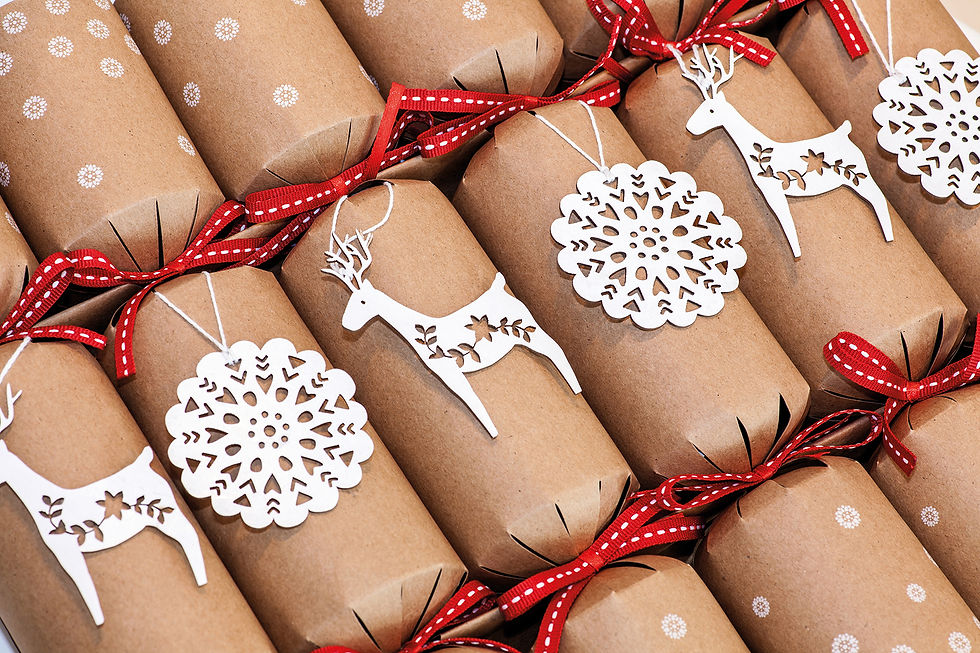
CRACKERS
The first Christmas crackers were made by London confectioner Tom Smith, inspired by the coloured wrappers on French bonbons and the sparks from his log fire. He gradually introduced paper hats, small gifts and mottos or jokes – the cornier the better!
A primary school in Buckinghamshire holds the record for the world’s longest Christmas cracker, measuring 207ft in length and 13ft in diameter, set in December 2001. The longest ever cracker pull chain was achieved by 1081 people, in 2015 at The Harrodian School in London.

MISTLETOE
Mistletoe grows on the branches of several species of tree; including willow, apple and oak. The tradition of hanging it in the house dates back to the ancient Druids, as it was reputed to possess mystical powers that bring good luck to the household and ward off evil spirits.
In Norse mythology it was a symbol of love and friendship, spawning the English custom of kissing under the mistletoe at Christmas time.

PRESENTS
The custom of giving presents at Christmas dates back to the Three Wise Men and their gifts of gold, frankincense and myrrh. Present-giving customs vary around the world, although the tradition of a mysterious gift bringer is fairly universal – whether it’s Father Christmas, St. Nicholas, Santa Claus or any another regional variation.
The place that he leaves these presents also differ. In most of Europe, the presents are left in shoes or boots put out by children. In Italy, America and, of course, Britain, presents are put in stockings; often hanging by the fireplace to allow Father Christmas easier access.
In many countries, presents are left under the tree and opened on Christmas morning with all the family together. This too has international variations.
Dutch children open their presents on December 5th – St. Nicholas’ Eve (Sinterklass), while children in Belgium have to wait for St Nicholas’ Day on December 6th, and in Germany, children typically open their presents on Christmas Eve (Heiligabend). American and Japanese children wait for Christmas Day, while in some Catholic countries, they have to hold out till Epiphany on January 6th.
Secret Santas have become a popular way for people to give an anonymous present to a randomly selected recipient – particularly at work or school Christmas parties.

PANTOMIME
A visit to the pantomime has become a much-loved English Christmastime custom; but its origins date back to the ancient Roman ‘Saturnalia’ midwinter feast, at which men dressed up as women and visa versa.
Pantomime first came to Britain in the 18th century from the ‘commedia
dell’arte’ – the Italian tradition of improvised theatre. Modern pantomime features a glittery array of pop singers, soap stars and TV personalities; as well as a lot of audience participation – joining in the songs, booing the villain and warning the hero that ‘he’s behind you!’


Comments